
Studio Help Blogs
Timber Stages and Batten Floors
May
Historically, many dancers grew up dancing in church halls and stages with strip timber floors. Although not all bad, the strip timbers had a significant degree of resilience; the floors, particularly those on stages, had a range of hard and soft spots that took their toll on dancers’ bodies. This is where batten floors come to play.
Dr Luke Hopper, a one-time dancer who specialises in Biomechanics, found that the highest injury rate occurred on the floor with the greatest variability in Force Reduction, even more than on floors with simply higher or lower average Force Reduction.
ResearchGateresearchonline.nd.edu.au
Hopper’s biomechanical study revealed that as force reduction decreases (i.e., the floor becomes harder), ankle joint kinematics and kinetics—such as dorsiflexion range, angular velocity/acceleration, plantarflexion moments, and power—all significantly increase.
Often, due to set down in the concrete slab being too great or the finish so out of the 3mm in 3 metre acceptable deviation that a self-levelling compound is not enough to make good, then battens, preferably hardwood, are required.
Battens are still commonly used under strip timber and onto a slab. This is not an appropriate surface for dance, and while there are no agreed global standards, they will not give the results recommended by the Australian Dance Council, among others and including EN standard 14904:

Similarly, if plywood or even worse particle boards are fixed directly to timber battens without cushioning, there is not a vast improvement from fixing directly to the concrete below.
Builders with little understanding of the needs of dancers’ bodies will often promote particleboard on battens as an acceptable, cost-effective dance floor solution.
They will do this because it is a relatively less costly medium that they know and understand. In the process, they miss the point of what the floor is intended to do.
There is no international supplier of performance flooring that would recommend particleboard as a subfloor. By manufacture and intent, chip or particle reconstituted material is very dense and, in comparison to plywood, “dead” with a much-reduced energy return. Since this energy return and shock absorption is the reason we are building a sprung floor in the first place, it defies reason to use a material that is going to lessen that result.
For a longer discussion of this go to Particle Board v Plywood on the Stm website.
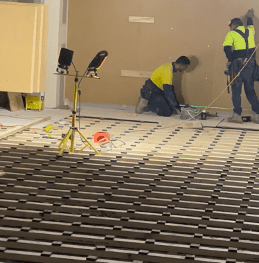
If battens are required for the reasons of level or set-down described above, short of building a basket-weave floor, it is simply a matter of adding resilient pads at the recommended spacings prior to the layer of plywood, as pictured above. Follow this with strip timber on plywood or plywood and vinyl, as your preference dictates.
To miss the opportunity to create a floor appropriate to dance and to save a few pennies will be a huge regret when the first and inevitable injuries occur.
Safe and Happy Dancing
Martin
